Our Project
The Motion Connect Collaborative consists of clinicians and researchers from 7 hospitals and 6 universities across Australia and New Zealand. The project is funded by the Medical Research Futures Fund for 4 years from 2024.
What is Gait Analysis
A systematic study of human locomotion, often involving the measurement and assessment of the patterns of movement during walking or running.
Gait analysis is the scientific study of how people walk and move. Over the past 50 years, it has evolved from clinicians visually observing movement to a sophisticated field that combines healthcare, engineering, biomechanics, data science and computer modelling.
Today, clinical gait analysis uses advanced technology to measure movement with a level of precision that cannot be achieved through observation alone. By combining information about joint motion, muscle activity, forces and physical examination findings, gait analysis helps clinicians and researchers better understand the causes of walking difficulties, pain, fatigue and reduced mobility.
Originally developed to improve care for people with neurological and musculoskeletal conditions, gait analysis is now widely used to support diagnosis, treatment planning, rehabilitation, research and innovation. Increasingly, it is also being used to develop predictive models that can help clinicians understand how different treatment options may influence future outcomes.
Motion Connect is helping accelerate this evolution by bringing together clinical gait data, advanced analytics and national collaboration to transform gait analysis from a tool that describes movement into one that can help predict outcomes, personalise treatment and improve care.
The purpose of gait analysis is to understand how and why movement differs from what is expected and how those differences affect function, participation and quality of life.
Gait analysis helps clinicians identify the causes of walking difficulties, pain, fatigue and falls, while providing objective information to guide treatment decisions. It can also be used to evaluate the effectiveness of interventions and monitor progress over time.
By combining clinical expertise with precise movement measurements, gait analysis supports more informed, personalised and evidence-based care for children and adults with movement disorders.
Clinical gait analysis combines specialised technology with clinical assessment to build a detailed picture of how an individual moves.
- 3D Motion Capture: Specialised cameras and reflective markers track movement in three dimensions, providing precise measurements of joint motion throughout walking.
- Force Plates: Force sensors embedded in the floor measure the forces generated between the feet and the ground during walking, helping clinicians understand how forces are transferred through the body.
- Electromyography (EMG): Small sensors record muscle activity and timing, providing insight into how muscles contribute to movement.
- Physical Examination: Assessment of strength, flexibility, alignment, motor control and other clinical measures helps clinicians understand the factors contributing to movement difficulties.
- Advanced Computer Modelling: Biomechanical models can estimate muscle forces, joint loading and movement mechanics that cannot be measured directly, providing deeper insight into how the body functions during walking.
Together, these assessments provide a comprehensive understanding of movement that supports both clinical decision-making and research.
Gait analysis is used across healthcare, research and human performance to improve understanding of movement and support better outcomes.
Research and Innovation: Advancing understanding of human movement and supporting the development of new technologies, predictive models and personalised treatments.
- Clinical Care: Assessment and treatment planning for conditions such as cerebral palsy, neuromuscular disorders, orthopaedic conditions and acquired brain injuries.
- Rehabilitation: Monitoring recovery and evaluating the effectiveness of treatment programmes.
- Surgical Planning: Supporting decisions regarding the most appropriate interventions and helping evaluate treatment outcomes.
- Sports and Performance: Understanding movement efficiency, reducing injury risk and supporting performance optimisation.
- Prosthetics and Orthotics: Assisting in the design and optimisation of braces, orthoses and prosthetic devices.
- Research and Innovation: Advancing understanding of human movement and supporting the development of new technologies, predictive models and personalised treatments.
Clinical gait analysis plays an important role in treatment planning for children and adults with complex movement disorders.
It is particularly valuable when decisions involve surgery, rehabilitation, orthotic management, spasticity treatment or other interventions that may significantly affect mobility and quality of life. By combining movement data with physical examination findings, imaging and clinical expertise, gait analysis helps clinicians understand the underlying causes of movement limitations and identify the treatments most likely to improve long-term outcomes.
As technologies such as predictive simulation, artificial intelligence and large-scale data analysis continue to develop, gait analysis is increasingly moving beyond describing movement problems towards helping predict outcomes and support truly personalised care. This is a key part of the future vision being developed through Motion Connect’s national collaborative research infrastructure.
Project History
Project Commenced
Data Dictionary Finalised
Databank developed and first data uploaded
Open Sim software completed
Databank launches
Our Workflow
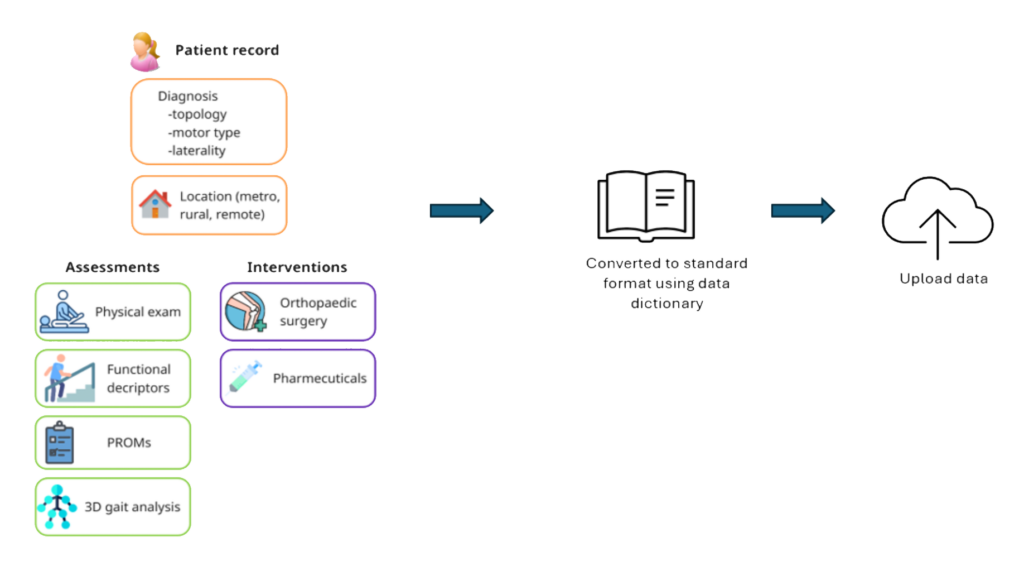
DATA PREPARATION
Clinical, patient and gait analysis data are reviewed, organised and converted into a consistent format before being securely uploaded for analysis and research.
DATA PREPARATION


HARMONISATION
OF MOTION CAPTURE DATA
Motion capture data from gait analysis (marker trajectories, ground reaction forces (GRF) and electromyography (EMG)) is automatically filtered.
HARMONISATION OF MOTION CAPTURE DATA
Marker trajectories:
- Re-labelled to consistent marker notations
- Rotated to consistent coordinate system
- Low-pass filtered (8Hz)
- Resampled to 100Hz
Ground reaction forces:
- Transformed to global coordinate system
- Rotated to consistent coordinate system
- Low-pass filtered (8Hz)
- Re-calculate centre of pressure
- Determine L and R foot strikes
- Resample to 1000 Hz
MUSCULOSKELETAL MODEL GENERATION
The filtered motion analysis data is then used along with demographic data (age, height, mass, and sex) to predict lower limb bone geometries. A custom OpenSim model is then generated.
MUSCULOSKELETAL MODEL GENERATION
Geometry prediction:
- An articulated shape model of the paediatric lower limb is used to predict bone geometries. For more information on this see [1].
- This provides patient specific bone geometries
OpenSim model generation:
- A custom OpenSim model is generated using these predicted bone geometries
- The hip joint is treated as a ball and socket joint
- The knee joint is treated as a hinge joint with an optimised knee axis calculated using the provided motion trials.
[1] Carman et. al (2024) https://doi.org/10.1016/j.jbiomech.2024.112211

KINEMATIC AND KINETIC ANALYSIS
Using the developed OpenSim model, inverse kinematics and kinetics are automatically calculated and displayed to the user.
KINEMATIC AND KINETIC ANALYSIS
Kinematics
- Spatiotemporal information
- Pelvis tilt, obliquity, rotation
- Hip F/E, Ab/Ad, IE Rot
- Knee F/E
- Ankle F/E, Inv/Ev
- Foot progression
Kinetics (moments & powers)
- Hip F/E, Ab/Ad, IE Rot
- Knee F/E, Ab/Ad, IE Rot
- Ankle F/E, Inv/Ev
UPLOAD DATA TO THE CLINICAL MOTION ANALYSIS DATABANK
Data produced by the workflow is uploaded to the clinical motion analysis database.
UPLOAD DATA TO CLINICAL MOTION ANALYSIS DATABASE
Data Uploaded
- Scalar values
- Kinematic and kinetic time series (normalised to gait cycle)
- OpenSim model
- Harmonised marker trajectories and ground reaction forces